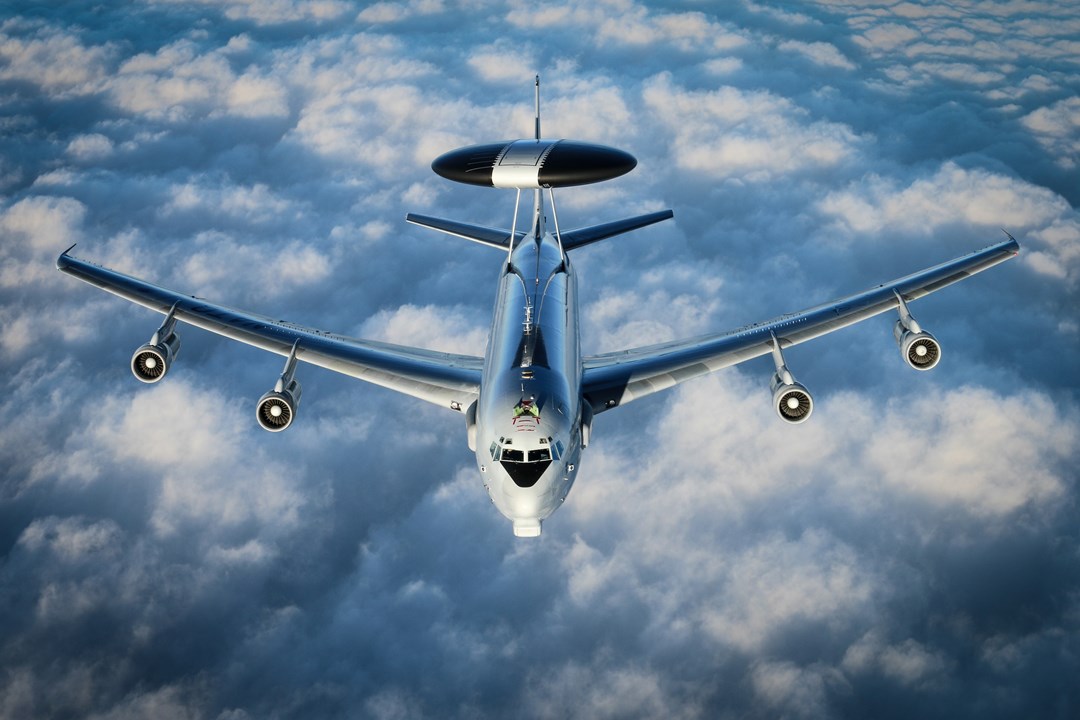
E-767
E-767
The E-3 Sentry is an airborne warning and control system (AWACS) that provides all weather surveillance, command, control and communications needed for modern air warfare. The E-3 is in fact a modified Boeing 707-320 commercial airframe fitted with a rotating radar dome. The dome is 9.1 meters in diameter, 1.8 meters thick, and is held 4.2 meters above the fuselage by two struts. It contains a radar capable of detecting airborne or surface (land or water) targets. The E-3 Sentry aircraft can detect targets at a maximum range of 400 km identifying them through a built-in IFF. Its look-down radar allows separation of airborne targets from the ground and sea clutter returns that usually confuse many radar systems. It provides 360-degree full coverage. During operation Desert Storm, in 1991, the E-3s from the United States assisted to 38 of the 40 air-to-air kills logged by the international coalition. Since then, the E-3 Sentry performed successfully during military conflicts over the former Yugoslavia and Iraq. Following the September 11 terrorist attacks, NATO E-3s were deployed over the United States performing homeland security missions. In the 1990s the Japanese Air Self Defense Force (JASDF) intention of purchase AWACS aircraft led to the development of the E-767 due to closure of Boeing 707 production line. The E-767, also known as the 767 AWACS, leverages the E-3 Sentry capabilities using a Boeing 767-200ER airframe instead of the 707-320. The twin-engine 767-200ER airliner is by far more capable than the aging 707. Japan initially ordered two aircraft in 1993 and increased this order by two more E-767s in 1994. First flight was in August 1996. Japan took delivery of its two first 767 AWACS in 1998 and the remaining two in 1999. The Boeing E-767 is fitted with Northrop Grumman APY-2 (originally was developed by Westinghouse) surveillance radar system mounted in a rotodome above the rear fuselage. APY-2 provides greater tracking capacity than its predecessor the APY-1 which was provided to early E-3 models. Powered by two CF6-80C2 turbofan engines each rated at 62,000+ pounds of thrust, the E-767 can fly faster, farther and at higher altitudes than E-3. To date, Japan remains the only E-767 operator. Encouraged by this development Boeing proposed further 767 military variants such as a tanker and transport aircraft.
deagel.com: https://www.deagel.com/x/x/a000541