ARMSNET
Military Equipment Database
Initializing 0%

Polyphem German Short-Range Cruise Missile
Spotted an error? Sign in to suggest an edit.
Basic Information
Name
Polyphem German Short-Range Cruise Missile
Designation
Alternate Designation
Trilateral fibre-optic guided missile system (TRIFOM), Polyphem-S, Polyphem-H, Triton
Equipment Type
Manufacturer
Date of Introduction
1994
Description

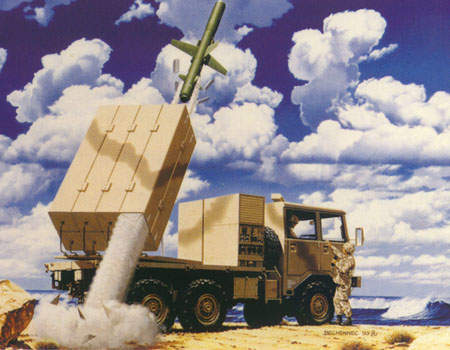
The Polyphem was a proposed light-weight fibre-optic wire-guided surface-to-surface missile with a range of 60 km. It used a solid propellant booster rocket to launch the missile out of its canister to an initial height so that the wings and control surfaces can unfold and a more fuel economic turbojet cruise engine would kick in to propel the missile. The missile could be programmed to follow a preset course, using GPS or inertial guidance. An infrared seeker could be used to automatically pick a target and for the terminal guidance phase, but it was also possible to transfer the thermal images back to the launching platform via a 200 MBit/s data link provided by an optical fibre, and manually select the target. The fibre-optic guided Polyphem missile was intended for two kinds of mission: isolated strikes from light land vehicles against long-range targets or from small ships or helicopters against land-based targets. The Polyphem program was started in 1994 by Germany, France and Italy. Italy later left the project. A naval version, called Polyphem-S, was initially selected for the Braunschweig class corvette as anti-ship and land-attack missile, but that has been cancelled. The Polyphem program as a whole was cancelled in 2003.

Variants
Polyphem-H Helicopter launched variant
Polyphem-S Ship launched variant
Triton Submarine launched variant
System
Alternate Designation Trilateral fibre-optic guided missile system (TRIFOM), Polyphem-S, Polyphem-H, Triton
Basing Submarine, Ship, Truck
Launch Platform(s) Braunschweig class corvette, Mercedes TEL
Effective Range 60 km
Circular Error Probability 1 m
Dimensions
Length 2.7 m
Missile Weight 130 kg
Diameter INA m
Fin Span INA m
Payload
Warhead Type Single
Warhead Options Conventional
Nuclear Yield NA mT
Conventional Warhead Weight 20 kg
Conventional Warheads Available Hollow charge with a hull of splinters
Multiple Independently targetable Reentry Vehicle (MIRV) Capable NA
Propulsion Characteristics
Engine Booster for launch and turbo-jet for flight
Propellant Solid
Speed 120—180 m/s (around 430—650 km/h)
Flight Ceiling 600 m
Minimum Altitude 20 m
Attack Altitude INA
Fire Control
Guidance System Primary guidance came from fiber optics to send and receive messages to and from the launch site. The missile was also capable of automatic flight using advanced image processing algorithms, electro-optical converters and radio links. The firing station has a global positioning system (GPS) Navstar navigation reference unit, a north-seeking device and a command, control, communications and information (C3I) system interface.
Details
Country of Origin Germany
Category Short-Range Cruise Missiles (SRCM) (Less than 600 km)
Air > Short-Range Cruise Missiles (SRCM) (Less than 600 km)
Filter Label
P
Classification
Domain
Air & Air Defense
Equipment Status
Active
Dimensions
Length
2.7 m
Width
Height
Weight
Operators (2)
France
Germany
Something went wrong. Please reload the page. Reload