Micro Uzi Israeli 9mm Submachine Gun
Spotted an error? Sign in to suggest an edit.
Other
Basic Information
Name
Micro Uzi Israeli 9mm Submachine Gun
Designation
—
Alternate Designation
—
Equipment Type
—
Manufacturer
—
Date of Introduction
1986
Description
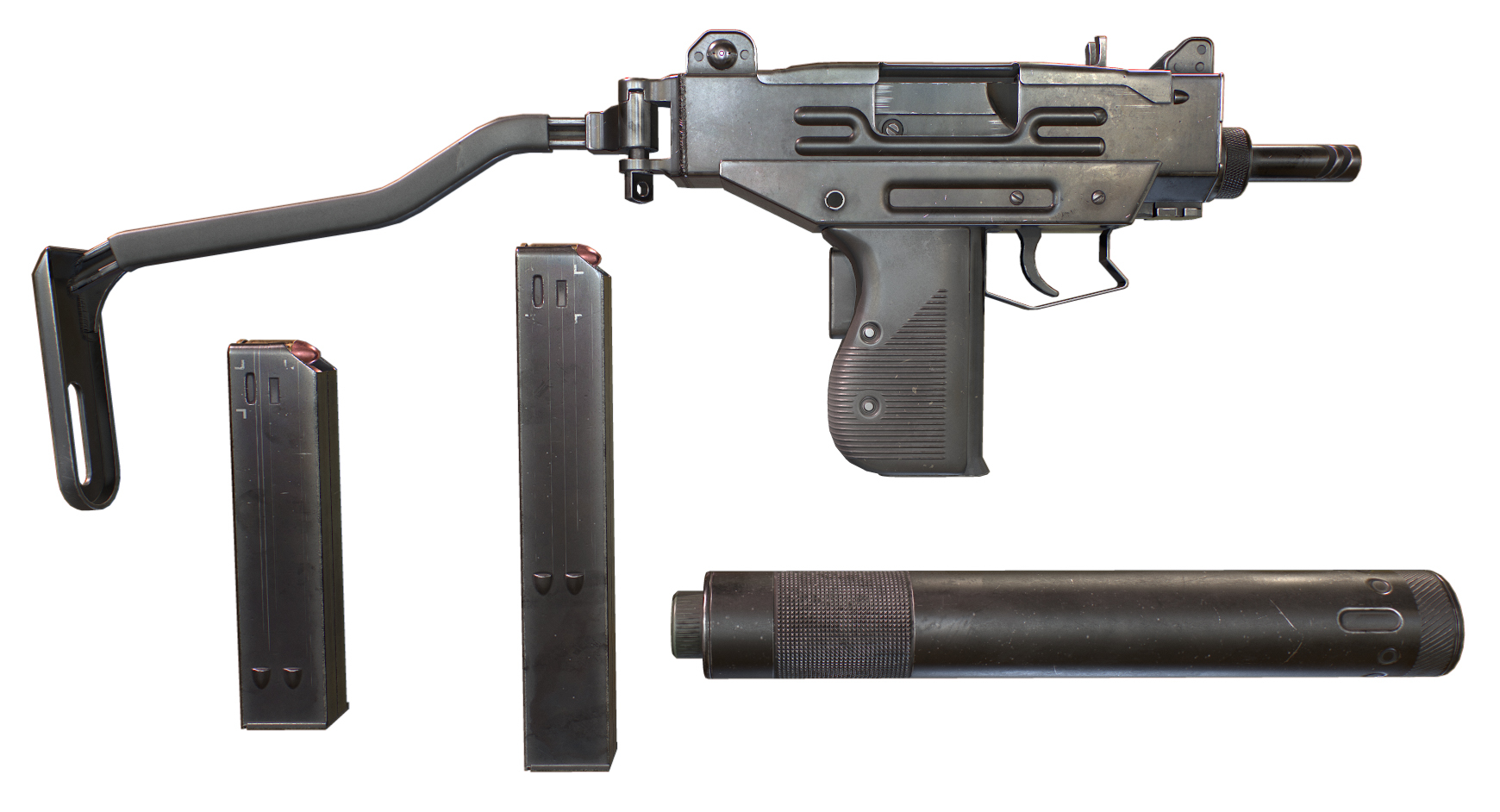
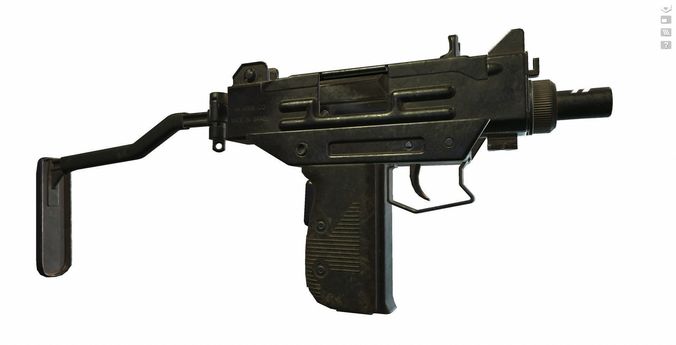
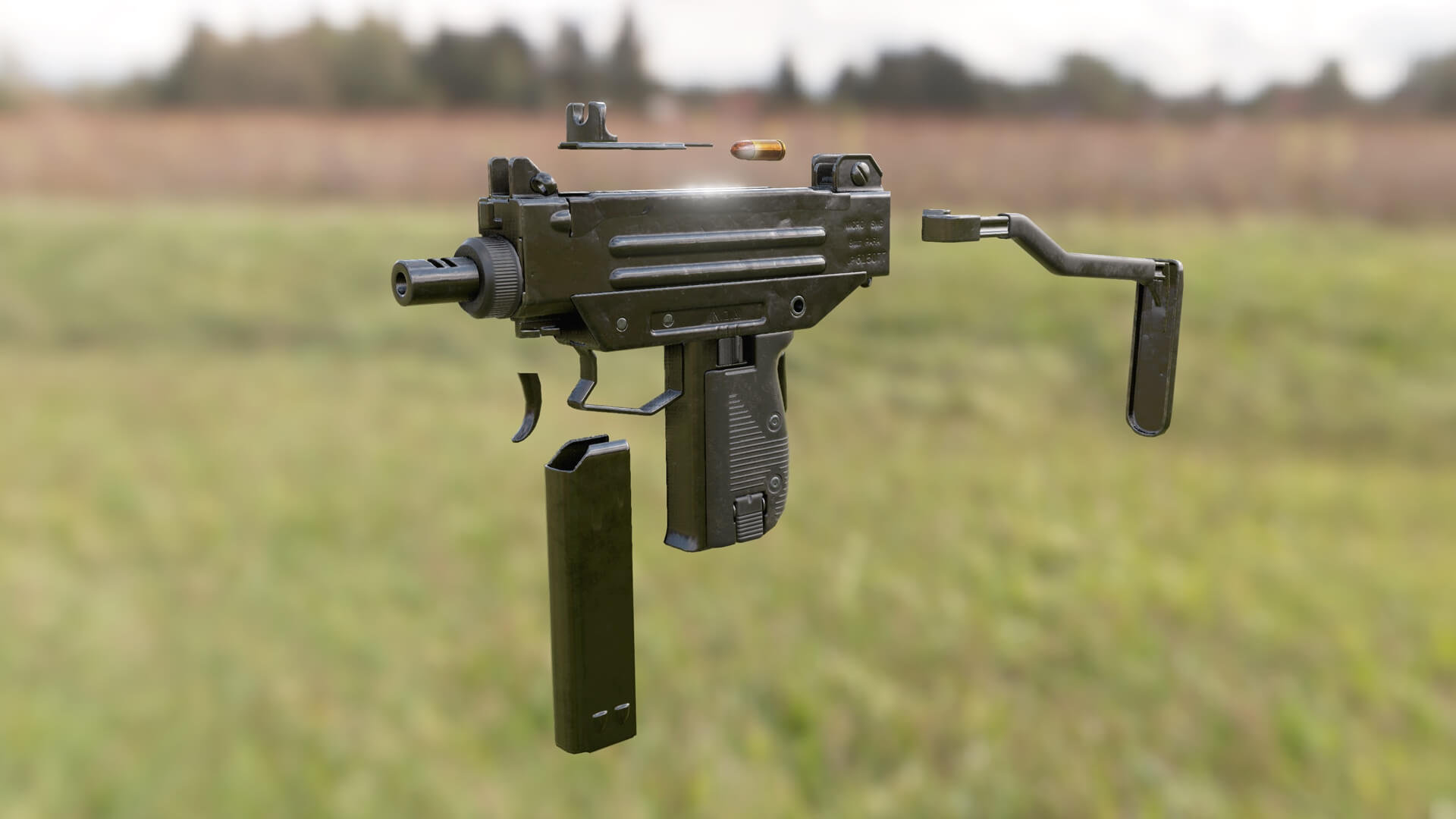
The Micro Uzi is an even further scaled-down version of the Uzi, introduced in 1986. The Micro Uzi is 486 mm (19.13 in) long, reduced to 282 mm (11.10 in) with the stock folded and its barrel length is 117 mm and has a closed bolt compared to its original counterpart. Its muzzle velocity is 350 m/s (1148 f/s) and its cyclic rate of fire is 1,200 rpm. It weighs slightly over 1.5 kg (3.3 lb)
Variants
Uzi Submachine Gun
The Uzi Submachine Gun is a standard Uzi with a 10-inch (250 mm) barrel. It has a rate of automatic fire of 600 rounds per minute (rpm) when chambered in 9mm Parabellum; the .45 ACP model's rate of fire is slower at 500 rpm.
Mini Uzi
The Mini Uzi is a smaller version of the regular Uzi, first introduced in 1980. The Mini Uzi is 600 mm (23.62 inches) long or 360 mm (14.17 inches) long with the stock folded. Its barrel length is 197 mm (7.76 inches), its muzzle velocity is 375 m/s (1230 f/s) and its effective range is 100 m. It has a greater automatic rate of fire of 950 rounds per minute due to the shorter bolt. Its weight is approximately 2.7 kg (6.0 lb). The Micro Uzi is an even further scaled down version of the Uzi, introduced in 1986. The Micro Uzi is 486 mm (19.13 in) long, reduced to 282 mm (11.10 in) with the stock folded and its barrel length is 117 mm and has a closed bolt compared to its original counterpart. Its muzzle velocity is 350 m/s (1148 f/s) and its cyclic rate of fire is 1,200 rpm. It weighs slightly over 1.5 kg (3.3 lb).
Uzi Pro
The Uzi Pro, an improved variant of the Micro Uzi, was launched in 2010 by Israel Weapon Industries Ltd. (I.W.I.), formerly the magen ("small arms") division of Israel Military Industries. The Uzi Pro is a blowback-operated, select-fire, closed-bolt submachine gun with a large lower portion, comprising grip and handguard, entirely made of polymer to reduce weight; the grip section was redesigned to allow two-handed operation and facilitate control in full-automatic fire with such a small-sized firearm. The Uzi Pro features four Picatinny rails, two at the sides of the barrel, which can be removed, one below the barrel for the addition of forgrips and one on the top for optics. The under barrel rail is often shown with a specialised foregrip which attaches to the pistol grip to form a hand guard. In addition, the cocking handle has been moved to the left side.[28] The new weapon weighs 2.32 kg and has a length of 529 mm with an extended stock, and 30 cm while collapsed. It has been purchased by the IDF in limited numbers for evaluation and it is yet to be decided whether or not to order additional units for all of its special forces
Uzi carbine
The Uzi carbine is similar in appearance to the Uzi submachine gun. The Uzi carbine is fitted with a 400-mm (16-inch) barrel, to meet the minimum rifle barrel length requirement for civilian sales in the United States. A small number of Uzi carbines were produced with the standard length barrel for special markets. It fires from a closed-bolt position in semi-automatic mode only and uses a floating firing pin as opposed to a fixed firing pin.[23] The FS-style selector switch has two positions (the automatic setting was blocked): "F" for "fire" (semi-auto) and "S" for "safe". Uzi carbines are available in calibers .22LR, 9mm, .41 AE, and .45 ACP.
The Uzi carbine has two main variants, the Model A (imported from 1980 to 1983) and the Model B (imported from 1983 until 1989). The Type A was the same as the fully automatic Uzi, while the Type B had a firing pin safety and improved sights and sling swivels. These two variants were imported and distributed by Action Arms.
The American firm Group Industries made limited numbers of a copy of the Uzi "B" model semiauto carbine for sale in the US along with copies of the Uzi submachine gun for the U.S. collectors' market. After registering several hundred submachine guns transferable to the general public through a special government regulated process, production was halted due to financial troubles at the company. Company assets (including partially made Uzi submachine guns, parts, and tooling) were purchased by an investment group later to become known as Vector Arms. Vector Arms built and marketed numerous versions of the Uzi carbine and the Mini Uzi.
Today, while the civilian manufacture, sale and possession of post 1986 select-fire Uzi and its variants is prohibited in the United States it is still legal to sell templates, tooling and manuals to complete such conversion. These items are typically marketed as being "post-sample" materials for use by federal firearm licensees for manufacturing/distributing select-fire variants of the Uzi to Law Enforcement, Military and Overseas customers.
Mini Uzi carbine
The Mini Uzi carbine is similar in appearance to the Mini Uzi machine pistol. The Mini Uzi carbine is fitted with a 500-mm (19.8-in) barrel, to meet the minimum rifle overall length requirement for civilian sales in the United States. It fires from a closed-bolt position in semi-automatic mode only.
Uzi pistol
The Uzi pistol is a semi-automatic, closed bolt, and blowback-operated pistol variant. Its muzzle velocity is 345 m/s. It is a Micro Uzi with no shoulder stock or full-automatic firing capability. The intended users of the pistol are various security agencies in need of a high-capacity semi-automatic pistol, or civilian shooters who want a gun with those qualities and the familiarity of the Uzi style. It was introduced in 1984 and produced until 1993.
Uzi Pro pistol
The Uzi Pro pistol is a current version of the Uzi pistol. It has rails on the top and bottom, and there is an optional stabilizing brace. Unlike any other Uzi variant, the Uzi Pro pistol has a side charging handle, rather than a top charging handle, and has a three-stage safety. There are three safeties on the Uzi Pro pistol: a thumb safety, grip safety, and a firing pin block. This model was intended for law enforcement and civilian use, due to the compact size, rails, and a semi-automatic rate of fire. Unlike other Uzi variants, the Uzi Pro pistol is only chambered for 9x19 parabellum.
Characteristics
Alternate Designation(s)
Uzi
Primary Function / Type
Submachine Gun
Manufacturer
Israel
Action
Blowback, Open Bolt
Rate of Fire
950 rds/min
Muzzle Velocity
350 m/s
Effective Firing Range
100 m
Cyclic Rate of Fire
1,200 RPM
Feed System
•10-round box magazine (.22 and .41 AE)
•12-, 16-, or 22-round box (.45 ACP)
•20-, 25-, 32-, 40-, or 50-round box (9x19mm Parabellum)
Note
has a closed bolt compared to its original counterpart.
Dimensions
Length, Total
486 mm
Length, stock Folded
282 mm
Barrel Length
117 mm
Weight
1.5 kg
Ammunition
Option 1
Type
Rifle
Caliber
9 mm
Cartridge
9mm Parabellum
Basic Load
See Magazines
Stocks
Note
There are different stocks available for the Uzi proper. There is a wooden stock with a metal buttplate that comes in three similar variations that was used by the IDF. The first version had a flat butt and straight comb and had hollows for a cleaning rod and gun oil bottle. The second had an angled butt and a straight comb and no hollows. The third had an angled butt and curved comb and no hollows; a polymer version is currently available from IMI. The wooden stocks originally had a quick-release base but the ones sold in the United States have a permanent base to be compliant with US gun laws.
Choate made an aftermarket polymer stock with a rubber buttpad that had a flat butt, a straight comb, and a permanent base.
In 1956, IMI developed a downward-folding twin-strut metal stock with two swiveling sections that tucks under the rear of the receiver. The Mini Uzi has a forward-folding single-strut metal stock that is actually an inch longer than the Uzi's. Its buttplate can be used as a foregrip when stowed. The Micro Uzi has a similar model.
Magazine
Note
The original box magazines for the 9mm Uzi had a 25-round capacity. Experimental 40- and 50-round extended magazines were tried but were found to be unreliable. A 32-round extended magazine was then tried and was later accepted as standard. The Mini Uzi and Micro Uzi use a shorter 20-round magazine. Available extended magazines include 40-, and 50-round magazines. Other high-capacity aftermarket magazines exist such as the Vector Arms 70-round and Beta Company (Beta C-Mag) 100-round drums.
The .45 ACP Uzi used a 16- or 22-round magazine, while the .45 ACP Micro Uzi and Mini Uzi used a 12-round magazine. A conversion kit by Vector Arms allowed the .45-caliber Uzi to use the same 30-round magazines as the M3 "Grease Gun".
Sights
Iron Sights
Adjustable
Yes
Caliber conversions
Note
The Uzi was available with caliber conversion kits in .22 LR or .41 AE. The operator just has to change the barrel, bolt and magazine. The .22 LR had 20-round magazines; the original IMI kit used a barrel insert while the aftermarket Action Arms kit used a full replacement barrel. The .41 AE also had a 20-round magazine; since it has the same bolt face as the 9×19mm Parabellum, only the barrel and magazine needed to be changed.
IMI also manufactured a .45ACP conversion kit both in full auto/open bolt with a 10.2" barrel for the 9mm SMG and a semi only/closed bolt with a 16" barrel for the carbine version. Magazine capacity is limited, with 2 sizes of 16 and 10 rds each.
Details
Country of Origin
Israel
Category
Submachine Guns (SMG)
Land > Infantry Weapons > Submachine Guns (SMG)
Filter Label
M
Classification
Domain
Ground
Equipment Status
Active
Dimensions
Length
0.49 m
Width
—
Height
—
Weight
1.5 kg
Operators (10)
Israel
Italy
Brazil
Estonia
Haiti
Honduras
Peru
Romania
Sierra Leone
Vietnam
Something went wrong. Please reload the page.
Reload