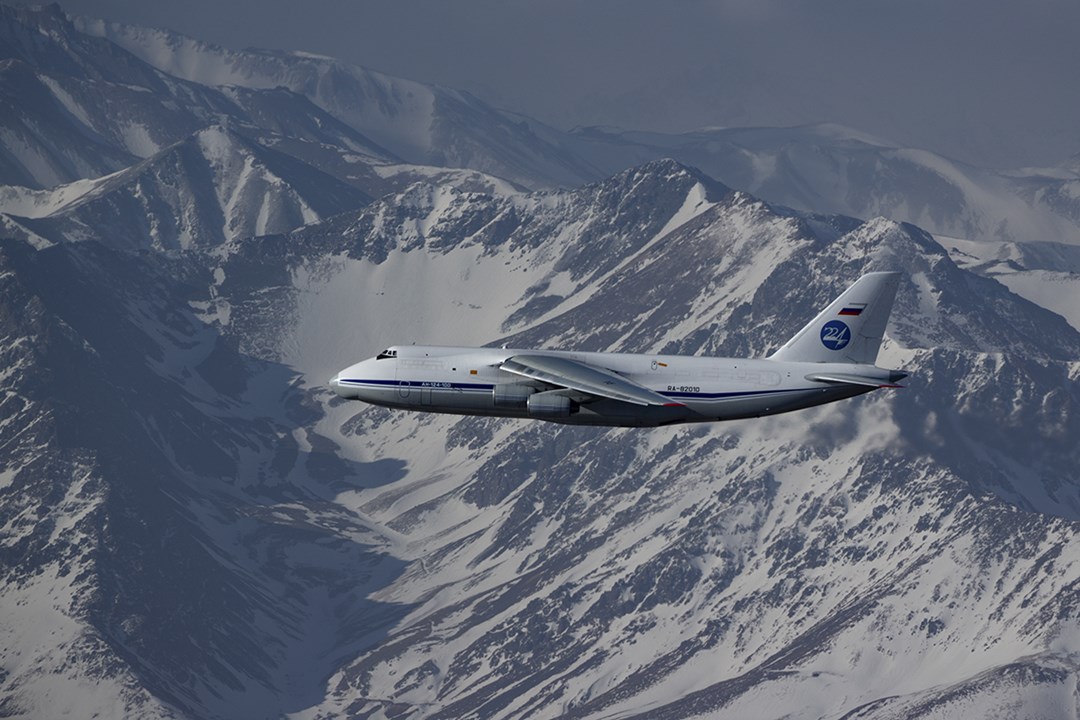
An-124 Ruslan
An-124 Ruslan
The Antonov AN-124 Ruslan, dubbed Condor by NATO, was designed to meet the requirements for an strategic airlift for the Soviet Air Force. It features a front and rear ramps for quick loading and unloading operations as well as onboard load handling equipment which allows load and unload without using airfield facilities. Its huge payload enables An-124 to airlift main battle tanks, several armored vehicles, and heavyweight equipment which are out of limit for medium-sized aircraft. The An-124 Ruslan is the Soviet counterpart to the US Air Force C-5 Galaxy large cargo aircraft despite the Ruslan surpasses the cargo capacity of its American counterpart. This aircraft has double-deck layout with the upper deck containing crew compartments and the lower deck a pressurized cargo compartment. It owns several airlift world records such as the delivery of the heaviest single cargo piece ever carried by air (a power generator weighting 135.2-t). The Ruslan was developed primarily to fulfill the needs of military customers with secondary cargo role for civil aviation, basically operated by the Soviet Union's Aeroflot airline. The An-124-100 designation refers to a variant intended for the commercial market transporting heavy and oversized cargoes which entered service in 1992. About 26 of -100 model were produced until 2004 for commercial operation. During the 1990s and early 2000s the An-124 was actively carrying commercial payloads or military payloads for European countries lacking in strategic airlift capability. Antonov developed a further version for the commercial market known as the An-124-100M-150 which is able to carry payloads between 120 and 150 tons. This improved An-124 can take off with a gross weight of 402 tons (420 tons foreseen) instead of 392 tons of previous models. Carrying a 120 tons payload the range has been increased from 4,650 km to 5,500 km. The new service life of 40,000 flight hours compared with 24,000 of the baseline An-124. New avionics, reinforced landing gear and other improvements were provided as well. It is expected that the D-18T series 3 powering the most modern An-124 will be replaced by series 4 in the An-124-100M-150 model. Russia's sponsored An-124 Aerial Launch project was aimed at delivering a satellite Carrier Rockets (CR) at high altitude facilitating costs reduction for putting into orbit missions. To do so, Antonov developed the An-124-100BC, also called An-124BC, model as the carrier rocket aerial launch platform. The An-124BC is a modified An-124-100 with the aircraft's tail end removed; a different cargo hatch construction; power supply and radio system removed; and addition of equipment for carrying and launching the Carrier Rocket (CR). The Carrier Rocket should be able to put into orbit payloads of 3 - 4 tons in low orbits; 1.5 - 1.7 tons in geotransitional orbits; and 600 - 800 kg into geosynchronous orbits. As of June, the Aerial Launch project is still under development. The An-124 entered service with the Soviet Air Force in 1987. Currently the An-124 and the Il-76 form the backbone of the Russian Air Force tactical transport aircraft fleet. They are expected to remain in service well into the 21st century. The Russian Air Force intends to replace the An-124 and Il-76 transports by a single aircraft, some sources suggested this new transport aircraft to be the Il-106, beginning in the 2010-2020 timeframe. Like many other programs in the Russian armed forces this replacement will depend on funds availability. As of early 2009 the Russian Air Force plans call for the upgraded versions of the Il-76 and An-124 aircraft to remain as the core of the strategic airlift capacity through 2030-2040. Antonov ASTC announced that the An-124 production line was again opened thanks to orders coming from Russian airlines, Poliyot and Volga-Dnepr, for five An-124-100M-150 aircraft each. All in ten An-124-100M-150 were set to be manufactured and delivered to both Russian carriers. This announcement was made public in August 2005 during MAKS 2005 international exhibition in Moscow, Russia. In January 2006, NAMSA (NATO Maintenance and Support Agency) and Ruslan SALIS GmbH, a company representing ANTONOV ASTC (Ukraine) and Volga-Dnepr (Russia), signed the SALIS (Strategic Airlift Interim Solution) program agreement. Under SALIS, two AN-124-100 airplanes will be constantly based in Leipzig airport, Germany, and another 4 aircraft will be put on disposal by request. The AN-124-100s will carry out strategic transportations in support of the European Community and NATO through 2012.
deagel.com: https://www.deagel.com/x/x/a000330