B1-B Lancer American Supersonic Strategic Bomber
B1-B
Spotted an error? Sign in to suggest an edit.
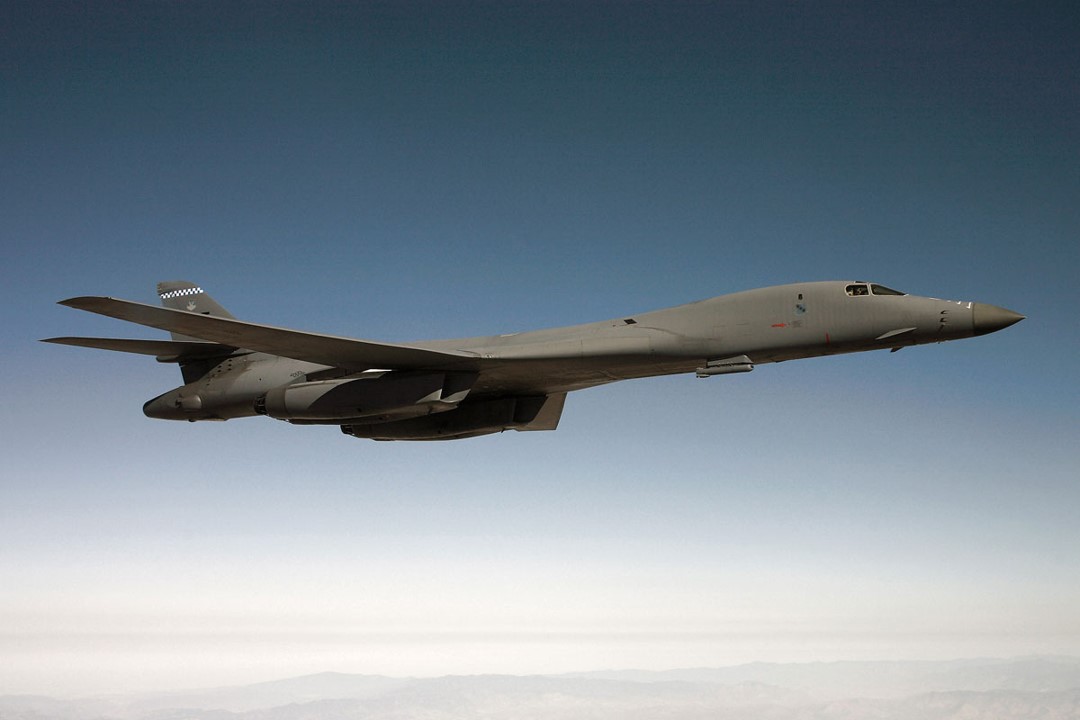
Other


Basic Information
Name
B1-B Lancer American Supersonic Strategic Bomber
Designation
B1-B
Alternate Designation
—
Equipment Type
—
Manufacturer
Boeing (originally developed by Rockwell International)
Date of Introduction
1984
Description
The B1-B Lancer American Supersonic Strategic Bomber manufactured by Boeing (originally developed by Rockwell International) in the United States. Development for the B-1B was revived in 1981 following the initial B-1A and first flight for the B-1B was completed in 1984. 100 B-1B bombers were manufactured until production ended in 1988 with the United States Air Force (USAF) as its sole operator.
Air & Air Defense Specifications
Crew
4
Engine
Turbofan (136 hp)
Max Speed
965.0 km/h
Range
11991.0 km
Service Ceiling
18000 m
Variants
B-1A Lancer
The B-1A Lancer, 4 x prototypes were part of the initial B-1 program. It had its first flight in December 1974. The program was cancelled in 1977.
System
Alternate Designation(s)
B1-B Lancer
Primary Function / Type
Supersonic Strategic Bomber
Manufacturer
Boeing (originally developed by Rockwell International)
Crew
4 ea
Number of Engines
4 ea
Number of Hard Points
6 x external hardpoints for ordnance
Maximum Payload Internal Weapons
34,019 kg (weapons)
Maximum Payload External Weapons
31,751 kg (weapons)
Maximum Wing Loading
1,194.2 kg/m²
Dimensions
Length
44.81 m
Height
10.36 m
Wingspan (Fully Spread)
41.67 m
Wingspan (Fully Swept)
23.84 m
Tail plane Span
13.67 m
Wheelbase
17.53 m
Wheel Track
4.42 m
Gross Wing Area
181.2 m²
Empty Weight
87,085 kg
Maximum Take-off Weight
216,365 kg
Maximum Fuel Weight
88,450 kg
Automotive
Engine Name
4 x General Electric F101-GE-102 augmented turbofans
Engine Type
Turbofan
Engine Power
Each rated at 136.9 kN (30,780 lb st)
Maximum Range
11,991 km
Maximum Speed
965 km/h
Service Ceiling
18,000 m
Avionics
Note
Quadruplex Automatic Flight Control System (AFCS) controls flightpath, roll attitude, altitude, airspeed, autot-hrottle, and terrain-following. The flight director panel has heading hold, navigation, and automatic approach modes. Central air data computer; gyro stabilisation systems; stability control augmentation system; and Structural Mode Control Subsystem (SMCS).
Standard Government Furnished Equipment (GFE) includes communications, IFF, ILS, intercom, some navigation equipment, Honeywell ASN-131 SPN/GEANS radar altimeter (similar to that in B-52), and altimeter indicator, rescue beacon, and transponder. Boeing Military Airplanes is responsible for the Offensive Avionics System (OAS). This includes a Singer Kearfott high-accuracy inertial navigation system (developed from that used in the F-16); a Teledyne Ryan AN/APN-218 Doppler velocity sensor, comprising a single antenna/receiver/transmitter unit; Westinghouse AN/APQ-164 multimode Offensive Radar System (ORS), derived from the AN/APG-66 in the F-16, which includes a low-observable phased-array antenna to provide low-altitude terrain-following and precise navigational functions; IBM Avionics Control Units (ACUs), including two for terrain-following based on those used in B-52 plus a Mass Storage Device (MSD), using AP-101C computers initially (1750As later) to provide program instructions for navigation, weapons delivery, bomb damage assessment, defensive system computation, and central integrated test.
Armament
Carriage and Release
Three internal weapons bays, comprising 9.53 m (31 ft 3 in) double bay forward of wing carry-through structure and a single 4.57 m (15 ft) long bay aft, with hydraulically actuated doors. Forward bay incorporates a movable bulkhead permitting accommodation of a wide variety of weapons, of various sizes, and mixed loads. Six external stores stations beneath fuselage, on which can be carried an additional 12 ALCMs.
Guided Weapon Systems
The forward and aft bays can be combined to carry eight ALCMs on a common strategic rotary launcher. Latest-generation GPS-guided precision weapons incorporated from CMUP Block D with Joint Direct Attack Munition (JDAM) and then Block E added AGM-154 Joint Stand-Off Weapon (JSOW) during 2003, with Wind Corrected Munitions Dispenser (WCMD) and Joint Air-to-Surface Standoff Missile (JASSM) following. The 500 lb GBU-38 JDAM was added in 2006 following operational testing with GBU-54 LJDAM following in 2011. AGM-158C Long Range Anti-Ship Missile (LRASM).
Unguided Weapons and Guns
Internal capacity for up to 38,328.5 kg Mk 82 bombs or 500 lb Mk 36 mines. From 1996 Block C CMUP CBU-87 capability was added and, in April 1997, Mk 62 Quick Strike underwater mine seeding capability was added.
Protection
Defensive Avionics System
The defensive avionics system, which is the responsibility of Eaton Corporation's AIL Division, is based on that company's AN/ALQ-161 system, which comprises AN/ALQ-161A Radio Frequency Surveillance/ECM System (RFS/ECMS), Tail Warning Function (TWF), AN/ASQ-184 defensive management system, and an expendable countermeasures system, totaling 108 separate elements. The current AN/ALQ-161 system, which will enable the B-1B to penetrate present and predicted enemy defenses well into the 1990s, is controlled by a network of digital computers, which can be reprogrammed easily; in addition, all electronic systems boxes ‘plug in' to a dedicated databus network, enabling system to be upgraded continuously to adapt to future threats until well into the 21st century. To protect the B-1B, the system must counter a very dense environment of signals from increasingly hostile radar networks. A single AN/ALQ-161 system contains and controls a large number of Northrop (Defense Systems Division) jamming transmitters and Raytheon phased-array antennas. In addition to jamming hardware, a sophisticated control system, managed by a network of special digital computers, is employed. This network can control the jamming chains so rapidly that each can jam signals from many radars simultaneously. The numerous jamming chains are deployed around the periphery of B-1B to jam signals in any frequency band coming from any direction. Integrated with the jamming control subsystem is an equally sophisticated network of separate receiving antennas, receivers, and processors, which act as ‘ears' of the system. By means of these, new signals can be picked up, identified, and jammed, with optimized jamming techniques, in a fraction of a second. One of the advantages of having the receiving function completely integrated with the jamming function is that it allows receiving system to detect new signals and continue to monitor old signals while jamming in the same frequency band.
EW Countermeasure
4-8 countermeasure receivers
Chaff/Flares
Yes
Details
Country of Origin
United States
Category
Fixed Wing Aircraft
Air > Fixed Wing Aircraft
Filter Label
B
Classification
Domain
Air & Air Defense
Equipment Status
Active
Dimensions
Length
44.81 m
Width
41.67 m
Height
10.36 m
Weight
216365 kg
Operators (1)
United States
Something went wrong. Please reload the page.
Reload